
Harari's Sapiens
What can we learn from the study of human history at a grand scale?
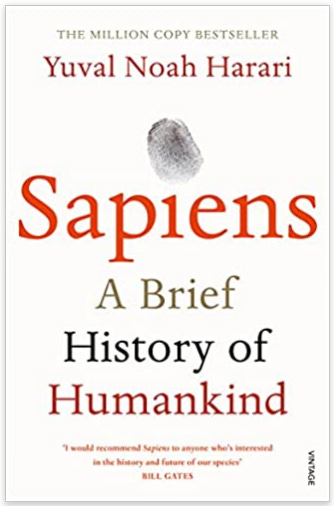
Sapiens are humans. In his best-selling 2014 book, Sapiens: A Brief History of Humankind, Yuval Noah Harari tells the story of human history, and he raises some very controversial questions. (See below for examples.)
But, first, What is Big History?
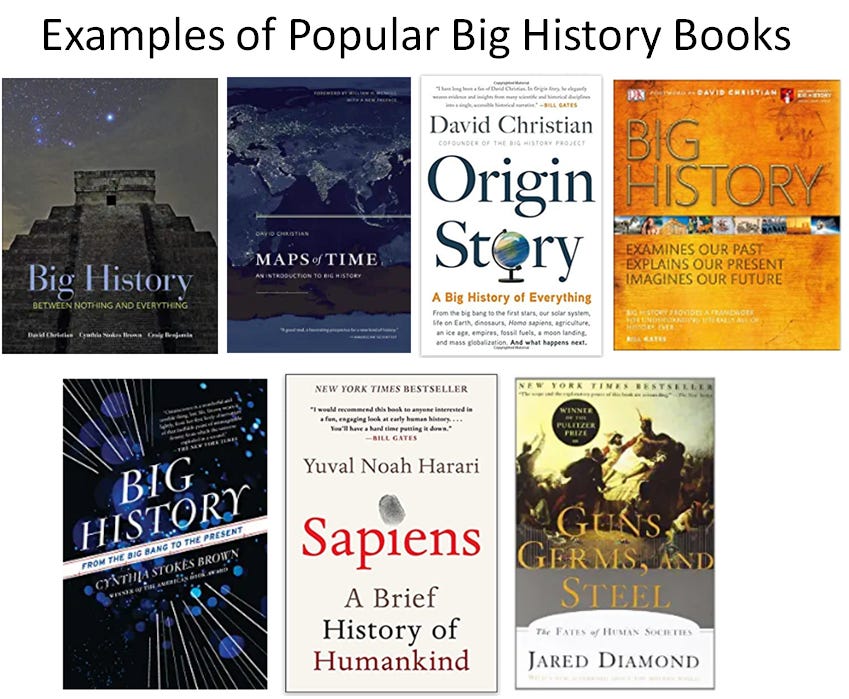
At one of my colleges, professors in my academic program used this book as the class textbook. The class studied history on a grand scale - “From the Big Bang to the Present.” This field of history is called “Big History.” It examines history from a very large scale, and it uses questions and evidence from many academic disciplines (philosophy, theology, astrology, physics, biology, history, anthropology, culture studies,…). Big History is most directly connected to the writings of David Christian (Professor at Macquarie University in Sydney, Australia, and San Diego State University in California), who published an influential journal article in 1991 called “The Case for Big History.”
In the article, Christian argues that the time scale you use to view history matters. For example, if you look at environmental changes in the last several decades, there will be spike in the data. But, if you look at much longer trends - several thousand years - the recent rise may be part of a regular up-and-down pattern. Focusing on different time periods will tell you a different story. Here is a chart from NASA about atmospheric carbon dioxide levels - focusing on the far right tells a different story than focusing on the rest of the chart:

Books on Big History identify several major historical events, called “thresholds.” These include:
The appearance of stars and planets in the universe.
The appearance of life on Earth.
The appearance of humans.
The shift in lifestyle from hunting-gathering to agriculture.
The development of writing and the industrial revolution.
The study of Big History gained major support (and funding) from Bill Gates. Today, there are several books, websites, and journals about Big History.
Sapiens…
Sapiens are humans (scientific name Homo sapiens). But they are a special kind of human. According to Harari, there were other species of humans! Humans first appeared in East Africa, and, as they spread into different regions, they evolved into different species of humans. Altogether, there were seven species:
Homo neanderthalensis (Neaderthals) in Europe
Homo erectus (Upright Man) in East Asia
Homo soloensis in Java in Indonesia
Homo floresiensis in Flores in Indonesia - these humans were about 3 ft tall and weighed only about 50 pounds
Homo denisova in Siberia, Russia
Homo rudolfensis in East Africa
Homo sapiens (Wise Man)
The last species of humans (Sapiens) was the only one that survived. The rest became extinct. Why? Were Sapiens smarter and better able to adapt? Were they better inventors - did they invent fire, the wheel, weapons for hunting? Or, did they happen to live in areas with more food, cleaner water, animals that were easier to hunt, and places with more natural resources?
Or, did Sapiens kill off the other humans and drive them to extinction through some pre-historic battle of survival?

Harari suggests two possibilities:
Intermixed Species. One possibility is that Sapiens started mixing with other human species (such as with Neanderthals in Europe), and that future generations became a mix of Sapien-and-Neanderthal species. The same could have happened in other areas. Instead of killing them off, Sapiens could have merged with other human species.
Replacement Theory. Another possibility is that Sapiens took over land that was occupied by other humans. How did they do that? This could be interesting…. Possibilities include:
Sapiens could have driven out Neanderthals (and other human species) through war and aggression … perhaps also through better coordination because of more advanced language and deadlier weapons.
Sapiens could have slowly won the non-violent competition for resources … such as animals for hunting, and fruit and berries for collecting. Sapiens may have been more resourceful, and the two species could not have been able to co-exist in the same location.
Other human species could have become extinct on their own … perhaps because of an inability to adapt to a changing environment or diseases or internal fighting. Then, the Sapiens would have moved into the recently-de-populated areas.
Hunting-Gathering vs. Agriculture
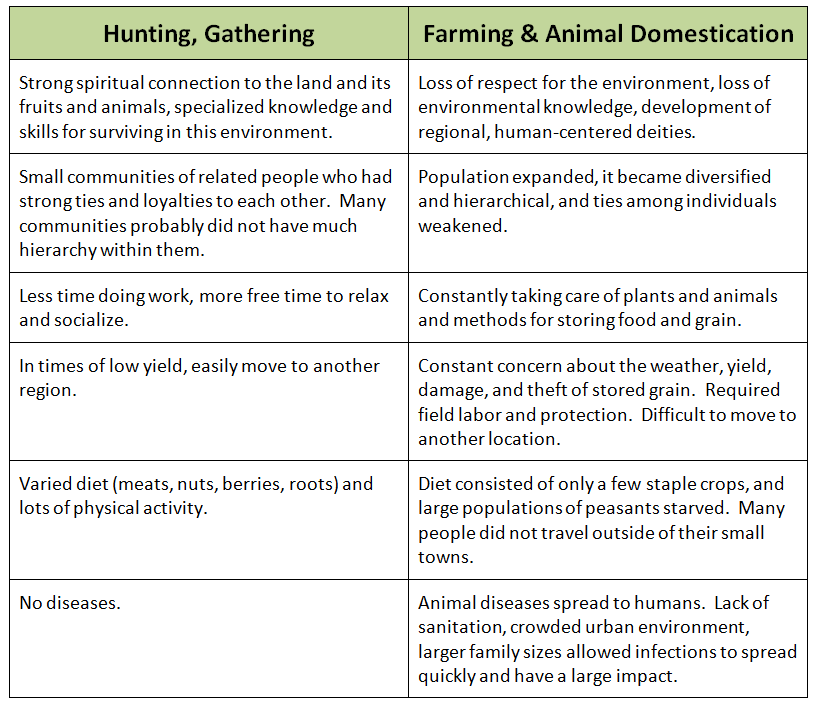
About 12,000 years ago, Sapiens transitioned from a hunting-gathering, nomadic lifestyle to a lifestyle of permanent settlement, agriculture, and animal domestication. When this happened varied from region to region. The Middle East and North-Eastern Africa was the first region, other regions followed later on, either as they discovered farming and animal domestication on their own, or as people began to travel and spread their knowledge.
The change in lifestyle brought many changes. It made food more abundant, and this allowed communities to get bigger. As this happened, people specialized in different skills (such as crafts, farming, warfare, and governance), and communities became diversified and hierarchical. The specialized skills also developed culture - crafts, story-telling, writing, religion.
But Harari does not think it was worth it. He thinks we were tricked. We got a bad deal. What do you think? Here is a list of differences:
If you enjoy this newsletter, please forward it to others and encourage them to subscribe.