
Goals and Measures
Setting goals and tracking the results.
Successful people and organizations set goals. The goals give them direction and focus. Goals also motivate them to aspire beyond their current level of performance. Once they achieve one goal, they set another, more ambitious goal.
Successful people and organizations also achieve their goals. In a way, “achieving the goal” is the definition of “success.” But how do you set effective goals? And how do you know you are on your way to success?
“SMART” Goals
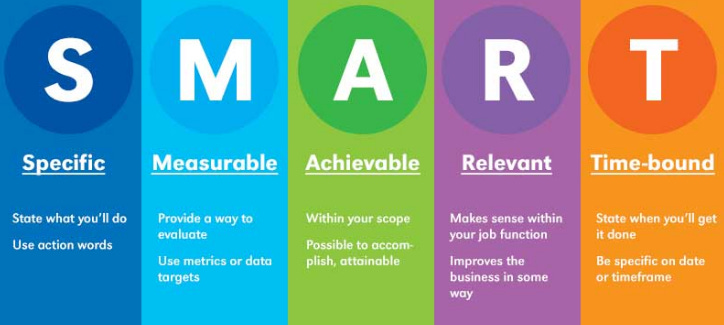
A common strategy for creating goals is the acronym SMART, which stands for:
Specific - The goal should identify a specific outcome or action, rather than a generic hope. For example, “lose weight” or “decrease my cholesterol” rather than “get healthier” or “become more fit.”
Measurable - The goal should be measurable so you know when you have succeeded. For example, “lose 20 pounds” or “decrease my cholesterol by 20 points.” The goal should also be “observable” (something you can see) - if you can’t see it, you can’t measure it. Weight and cholesterol are something you can measure, health and fitness are too vague.
Achievable - Your goal should challenge you and inspire you, but it should not be so lofty that you can’t achieve it. Goals that are too challenging may intimidate and discourage you. Set a goal that is just beyond your current level, then set another one when you succeed. Losing 20 pounds is much more realistic than losing 100 pounds.
Relevant (or Realistic) - Some charts say “realistic” instead of “relevant,” but I like “relevant” more. Set an important goal that is worth achieving. The goal could reflect a personal value, or it could be related to your organization’s strategic plan. For example, improving your health and cutting expenses are a valuable goals, but playing computer games at work is probably not.
Time-Bound (or Timely) - The goal should have a specific time window: a month, a financial quarter, six months, a year, five years. At the end of the time period, you’ll do your final measurement and see if you succeeded. Without a time window, the goal could go on forever. For example, “lose 20 pounds between Jan. 1 and Mar. 31.” One of my time-specific goals right now to read a book every week - I can usually do it, but longer books take two weeks.
Goals and Measures
A popular strategy for goal-setting in large organizations is the “Objectives and Key Results” method. (It has other names: “Objectives and Key Performance Indicators,” “Management by Objectives,” “Goals and Indicators.” I like the generic “Goals and Measures” because it is easier.)
The “Objectives and Key Results method” was made famous by Andrew Grove (co-founder and legendary CEO of Intel in the 1980s and 1990s). He used this strategy at Intel, and he taught other Silicon Valley CEOs to use it as well. Today, the Objectives and Key Results method is used at Google, the Bill Gates Foundation, and many other organizations. Andrew Grove presented the idea in his popular book High Output Management, and John Doerr’s recent book Measure What Matters describes how large organizations like Google are using OKRs today.
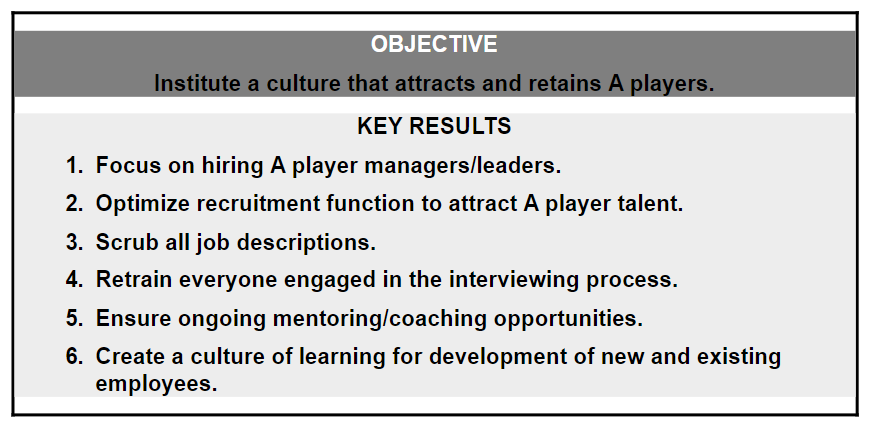
The idea is that you list Objectives (or Goals) on one side (or at the top), and Key Results (or measures) on the other side (or below). Objectives-Goals are what you want to accomplish. Key Results (or measures) are how you know you are on track; measures track progress. Here is an example from Lumeris (a healthcare technology company in St. Louis) John Doerr includes in his book:
Goals or “Objectives”
The “SMART” Goals method is useful for writing objectives. Goals are based on organizational values, strategic plans and priorities, and personal values.
Generally, goals should not reflect day-to-day work. Instead, they should help you accomplish a large project that is meaningful and important for both the organization and yourself. Goals are more about projects than daily operations.
Measures or “Key Performance Indicators”
Measures (or “results” or “performance indicators”) describe the steps necessary to achieve the goal. Because of this, each goal has several measures. When you accomplish each measure, you have met your goal. Measures also usually include numbers.
For example, to “lose 20 pounds in 3 months…”
You could divide your goal into monthly increments: “Lose 5 pounds in Month 1, 7 pounds in Month 2…”
You could also list strategies to help you lose weight: “Walk 2 miles three times per week, no snacks between lunch and dinner, half-size dessert only after dinner.”
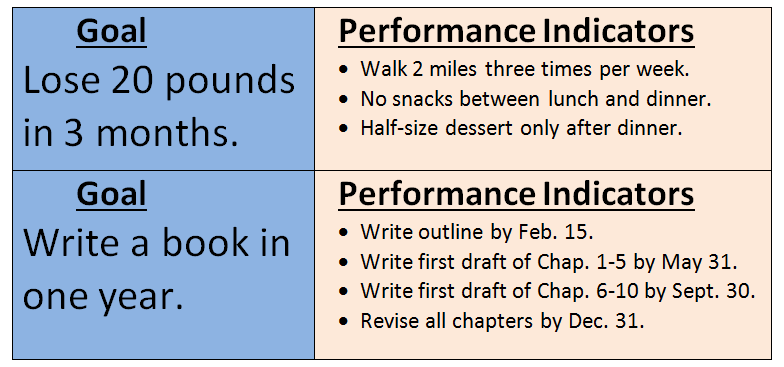
You can reach your goals - and become successful - by first meeting your results or indicators. Go walking three times a week, and stop eating snacks and dessert, and you’ll lose weight. Write one chapter at a time, and you’ll finish your book.
Reflection and Application …
Take a few moments now and write a goal. Is it specific and meaningful?
Identify smaller steps that are necessary for accomplishing that goal. If you still have too many big steps, divide them even further.
Place each step in order.
If you perform each step, will you accomplish your goal?
Thank you for reading my newsletter. I am interested in helping people and organizations achieve better productivity and success. You can read my previous newsletters on the archive.
Consider sharing this newsletter with others, or consider subscribing.