
Frankenstein
Who is the Real Monster - the Story of a Famous Halloween Character
Frankenstein is one of the most recognizable characters today. He appears in cartoons, movies, and comic books, and he is one of the most popular Halloween costumes. Frankenstein has a green face and a square head, with a scar across his forehead and bolts on his neck. He is tall, and he walks with stretched-out arms and stiff legs.
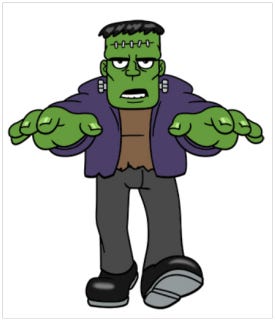
Frankenstein’s size suggests his strength. You can imagine how those hands could beat you or squeeze you to death.
What’s frightening about Frankenstein is that he is un-dead. He is a collection of dead body parts that were “put together” by Dr. Victor Frankenstein, a genius scientist and medical student who wanted to create a new type of man. Victor stitched together body parts, and he brought the creature to life by shocking it with electricity from a lightning bolt. Many movies show this famous “It’s Alive” scene, where lightning strikes the rods and brings the creature to life.
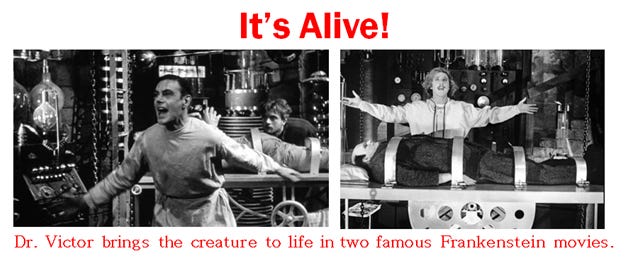
This version of Frankenstein is based on Boris Karloff’s character from the famous 1931 movie. This story presents Dr. Victor as a “mad scientist” who creates a dangerous monster in his lab and unleashes a danger upon the world. This story is a warning against the dangers of “crazy” scientific research.
But there are other important stories too.
The Original Frankenstein
Frankenstein is a novel that was written by Mary Shelley in 1816 and published in 1818. At the time, Mary was only 18 years old, and she was travelling through Europe with British poet (and her future husband) Percy Shelley. During the Summer of 1816, she and Percy met with Lord Byron (another famous British poet), and he challenged them to write a ghost story. After many days of thinking, Mary Shelley had a dream about a scientist who brings a monster to life, and she produced Frankenstein.
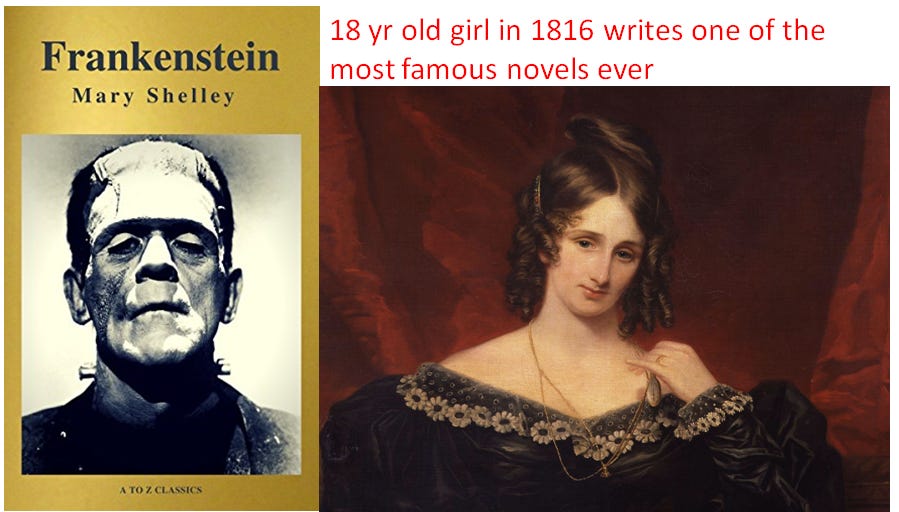
Frankenstein is one of the most famous novels today - many students read it in high school and college - and some scholars consider Frankenstein “the first science fiction novel.” And the story of a mad scientist who creates a monster in his lab has become a cultural myth - a story that lives outside the novel. There are now over 70 Frankenstein movies, a ton of academic scholarship about it, and many toys, costumes, and pictures about Frankenstein throughout the world.
Mary Shelley created a story like no other, and it has become a part of our entertainment and scientific history.
A New Man
In the novel, Victor Frankenstein is an ambitious scientist and medical student who wants to discover “the elixir of life.” He has three major motivations:
He likes overcoming challenges through learning, and he saw the mystery of life as the biggest challenge: “It was the secrets of heaven and earth that I desired to learn.” “The world was to me a secret which I desired to divine.”
He is ambitious for personal glory: “What glory would attend the discovery.” “More, far more, will I achieve … I will pioneer a new way, explore unknown powers, and unfold to the world the deepest mysteries of creation.”
He hopes to be a pioneer for something good in the world: “I could banish disease from the human frame and render man invulnerable to any but a violent death!”
By giving life to a new man - one stitched together from the best parts of many men - Victor hoped to be a god of a new, superior species.
But, the lightening severely burns the creature, and Victor quickly becomes frightened by him. He regrets what he has done, and he vows to destroy the creature. Instead, the creature takes revenge on Victor’s family.
Monster as Sympathetic Creature
When the creature wakes up, he is overcome with new sensations, and he runs away to get away from the pain and confusion. People in town become horrified by him and beat him, and he quickly learns to hide. For the next few years, he lives close to a family with a blind old man. He learns to speak and read by spying on the lessons of their kids and by stealing books. He learns about himself from Victor’s science journal, and he learns about history and the world through books and personal experience.
Eventually, the creature starts to kill members of Victor’s family. He does this as revenge for the way Victor abandons him, and he also does it to pressure Victor into meeting his demands for a better life.
Although the creature becomes murderous, he was born “innocent.” He is an emotional character who feels betrayed by Victor and by human society more broadly, and his story makes him a very sympathetic character. Readers often feel that the creature was an un-loved character who becomes violent as a way of inflicting pain to get what he wants.
Who is the Real Monster?
It’s funny that Victor’s name is “Frankenstein.” The creature - who we now call Frankenstein - actually doesn’t have a name. In the book, he is called “the creature” and “the monster.”
One of the big questions of the book is Who is the Real Monster?
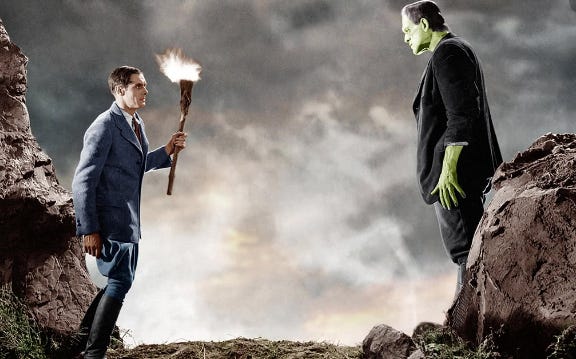
Victor believes that his creature is a monster because he has no soul - he was created by Victor, not by God. The monster also kills much of Victor’s family.
The creature feels lonely and emotionally hurt that he has been abandoned and cursed by his creator. The creature feels that Victor is violating his natural responsibility as “father” and creator. In a way, he is a bad parent. Victor can also be seen as a monster because he is a “mad scientist” who unleashes a danger in the world.
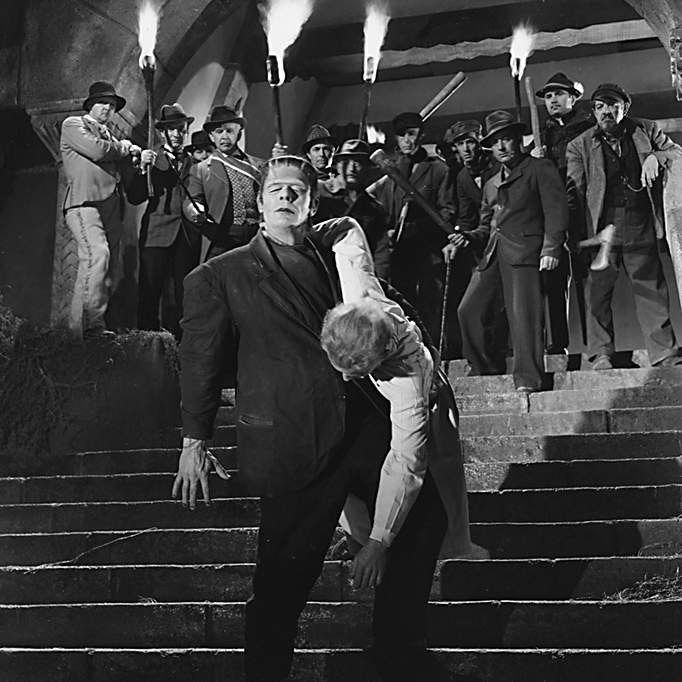
Human society can also be seen as a monster because it does not accept the creature. People become fearful and violent against the monster. In many Frankenstein movies, an angry mob tries to destroy the monster with pitchforks and clubs. If the creature is born “innocent” and driven to violence by society, then perhaps society is to blame.
What do you think? What does the story of Frankenstein tell us? Feel free to reply to this email.
Thank you for reading my newsletter. I enjoy writing about literature, history, and culture. If you missed my previous newsletters, you can find it on the archive. Please consider sharing this email with others.